

What do multiple arrests in Indonesia mean for Europe’s biofuels policy?
Handcuffed, masked and clad in a pink vest, Fadjar Donny Tjahjadi, the Indonesian Technical Director of Customs, is led towards a prison vehicle. Alongside ten other suspects, including two civil servants and eight private industry players, he stands accused of facilitating the export of hundreds of millions of euros worth of crude palm oil, illegally mislabelled as Palm Oil Mill Effluent (POME).
Still in custody, the suspects face charges of tax evasion that could carry sentences of up to life in prison.
As reported today by investigative journalists, Source Material, those arrested have been supplying POME to the EU’s top biofuel producers, including Eni, Repsol and Neste.
For European policymakers, the images should be striking. Waste biofuels have been a big part of Europe’s green energy transition. Most recently, they have been utilised in the push back against the CO2 regulation as an offset option for car manufacturers to continue selling internal combustion engines after 2035.
But for years, NGOs, industry insiders and several EU governments have warned that something was wrong with the bloc’s rapidly growing consumption of imported waste-based biofuels.
Now, those concerns have come to a head.
Europe’s favourite biofuel feedstock
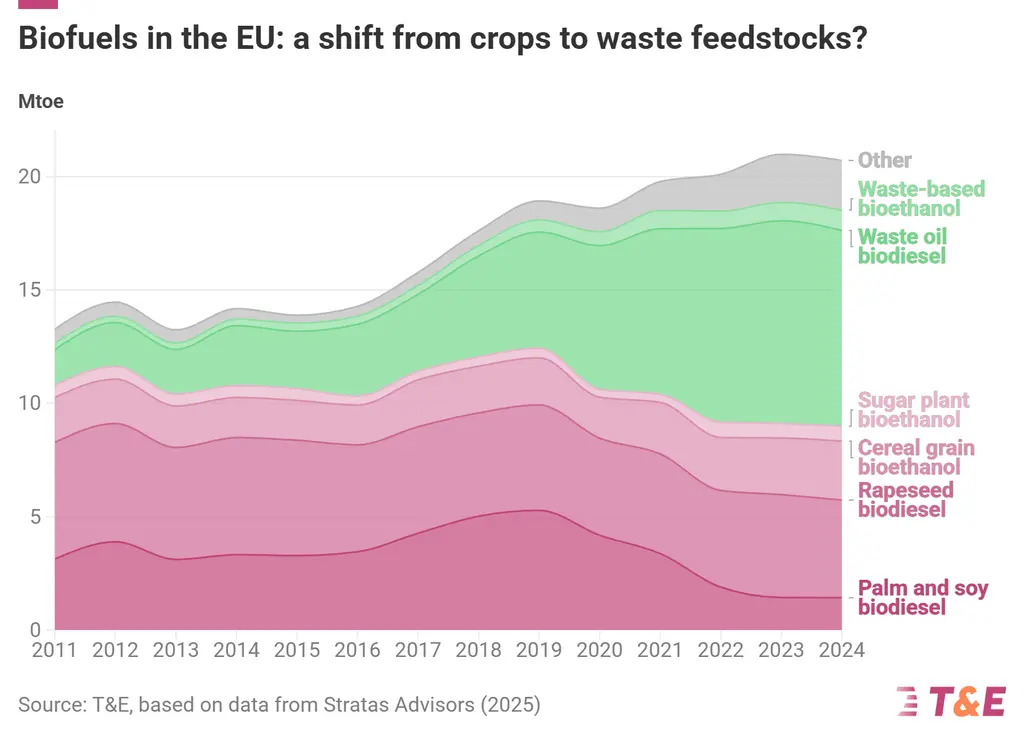
Over the past five years, the EU’s biofuels market has undergone a profound transformation.
In 2019, the EU decided to phase out the use of palm oil in biofuels due to its links with deforestation and land-use change. Attention immediately turned to biofuels made from “waste” materials, such as POME and Used Cooking Oil (UCO), which, in theory, should not drive additional land demand.
However, the sudden surge in demand raised an obvious question: how much of this stuff actually exists?
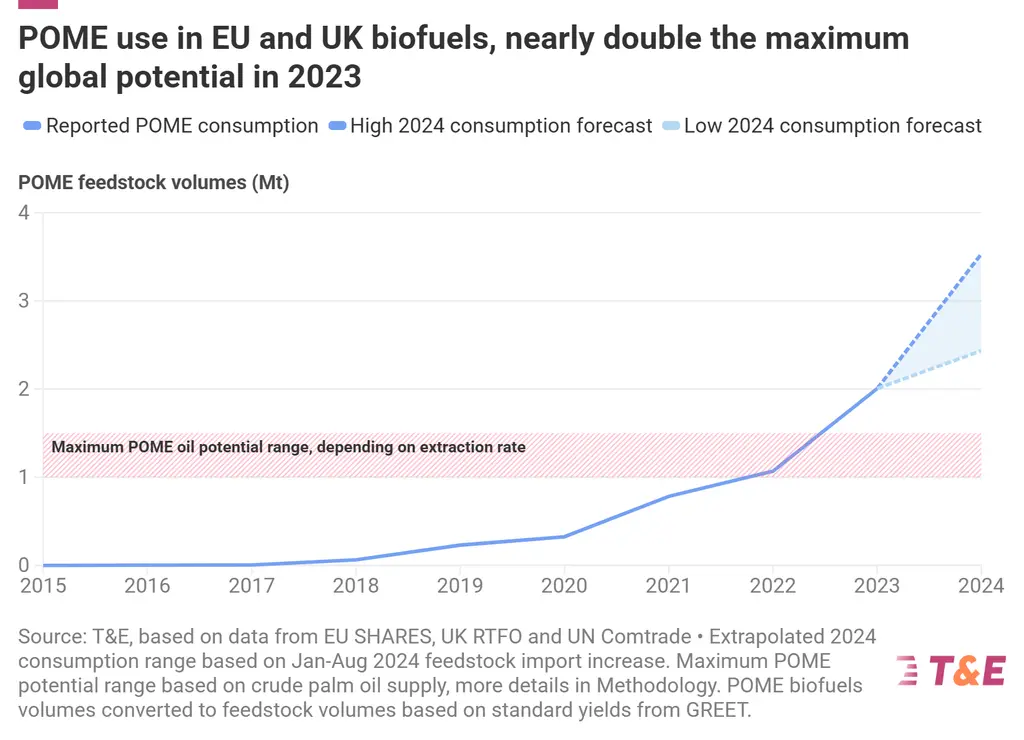
Between 2022 and 2025, Europe’s consumption of biofuels made from imported POME skyrocketed, rapidly turning the obscure residue into the one of the largest feedstocks for green fuels like Hydrotreated Vegetable Oil (HVO) and Sustainable Aviation Fuel (SAF).
An unheard of industry by-product had become a key ingredient of Europe’s transport energy transition almost overnight.
Growing doubts
Concerns about the integrity of these supply chains did not appear suddenly. They have been building for years. Early warning signs were raised as far back as 2021, when T&E published its first report on UCO, labelling the reliance on the feedstock as “dubious”. This was then followed in 2023, when T&E highlighted how Europe’s rapidly growing reliance on imported waste was creating strong incentives for fraud and mislabelling.
The following year, two deep dives on UCO imports further raised concerns about both the available supply of UCO and of the certification system responsible for verifying the feedstock.
The issue was raised politically within the EU, with both Belgium and Ireland raising the question of fraud at the EU Council, warning that both UCO and POME supply chains are vulnerable to manipulation.
All of these events led to T&E’s most significant publication on the matter. In 2025, T&E report, “Palm oil in disguise” showed clearly how Europe’s consumption of waste-based biofuels appears to exceed plausible global supply, arguing that palm oil may well be entering the EU market disguised as waste feedstocks.
The Indonesian arrests arrive shortly afterwards.
Why the arrests matter for Europe
The investigation in Indonesia suggests that these warnings were justified.
If crude palm oil was indeed being exported as POME, the implications go far beyond tax evasion in Indonesia. It would mean that fuels counted as “advanced” or “waste-based” in Europe may in reality have been produced from the very crop the EU sought to phase out.
That matters because EU biofuel policy is built on a strict hierarchy of feedstocks. Crop-based fuels face caps and restrictions. Waste-based fuels, by contrast, receive generous incentives and can count multiple times their value towards renewable energy targets.
The system assumes that regulators can reliably distinguish between the two. This assumption has finally been officially upended.
A structural problem
The problem is not necessarily limited to one country or one investigation. The structure of the market itself creates powerful incentives for mislabelling.
Waste-based biofuels command a premium because they count more towards climate targets. Meanwhile, verifying the origin of residues thousands of kilometres away is notoriously difficult, if not impossible.
As former EU Commissioner for Energy, Kadri Simson, admitted in 2024, European authorities lack the legal powers to inspect facilities outside the EU. In other words, Europe’s energy transition increasingly depends on supply chains it cannot directly police.
A moment of truth for EU biofuels policy
The Indonesian arrests should mark a turning point.
For years, Europe’s renewable transport strategy has leaned heavily on the idea that waste-based biofuels can scale quickly without environmental downsides. The explosive growth of waste imports post-2019 confirmed that narrative.
Now the EU must face an uncomfortable reality. The apparent abundance of “sustainable” biofuel feedstocks could be, at least partly, an illusion.
That raises difficult questions for policymakers.
How can Europe tighten verification rules for imported waste feedstocks? Should limits be placed on high-risk materials such as POME and imported UCO?
Or more importantly, how can the bloc accelerate the shift toward electrification and truly low-risk fuels?
From scandal to policy shift?
The images from Jakarta of a senior customs official in handcuffs, accused of facilitating biofuel fraud are not going to fade quickly.
They are a stark reminder that climate policy does not operate in a vacuum. When millions of euros in incentives meet opaque global supply chains, the risk of abuse grows.
For Europe, the question is no longer whether fraud is possible. It is now clear it is happening.
The question should be whether the current biofuels system is robust enough to prevent it or whether the POME arrests are just the first crack in a much larger story.
This article has been republished from The Transport & Environment.