
Global warming is already costing farmers over $20 billion a year, and the losses could climb eightfold by 2100 as heat and drought squeeze maize, wheat and soybeans
Heat extremes and drought linked to global warming are already imposing a multibillion-dollar annual cost on three of the world’s most important crops, with new research estimating that climate-driven losses to maize, wheat and soybean production have amounted to roughly $400 billion over two decades. The analysis suggests that recent increases in extreme heat and drought have reduced yields by about 3.5% compared with an earlier climate baseline, a seemingly modest percentage that translates into enormous losses once applied across global agricultural markets.
According to the official European Geosciences Union research abstract, researchers Corey Lesk, Yi-Ling Hwong and Kai Kornhuber calculated that climate-related yield impacts produced approximately $400 billion in global economic losses between 2000 and 2019, equivalent to more than $20 billion a year on average. The study, presented at the EGU General Assembly 2026, focused specifically on heat and drought damage to maize, wheat and soybeans, meaning the estimate does not represent the full financial cost of climate change across global agriculture.
Researchers linked decades of crop yields to heat and drought
The team began with national crop-yield data and compared it with historical climate conditions, examining how extreme temperatures and drought corresponded with changes in maize, wheat and soybean production. Drought was assessed through estimated moisture stress, while statistical relationships between climate extremes and crop yields during an earlier baseline period were used to estimate subsequent losses and project how the damage could evolve as the planet continues to warm.
The researchers estimated that rising heat extremes and drought reduced yields by about 3.5% relative to the 1974–2004 baseline during the more recent period examined. They then translated lost production into financial damage using agricultural price data, allowing the physical effects of climate stress to be expressed as losses to farmers and the wider economy.
According to the International Institute for Applied Systems Analysis research record, the work was carried out by researchers affiliated with IIASA and Université du Québec à Montréal, with the analysis designed to quantify the financial consequences of climate-driven crop losses rather than looking only at tonnes of food lost. The results also show that the burden is highly unequal: least-developed countries experienced losses equivalent to about 0.10% of GDP, compared with 0.04% in wealthy countries, making their GDP-normalized impact roughly 2.5 times greater.
Future losses could become dramatically larger
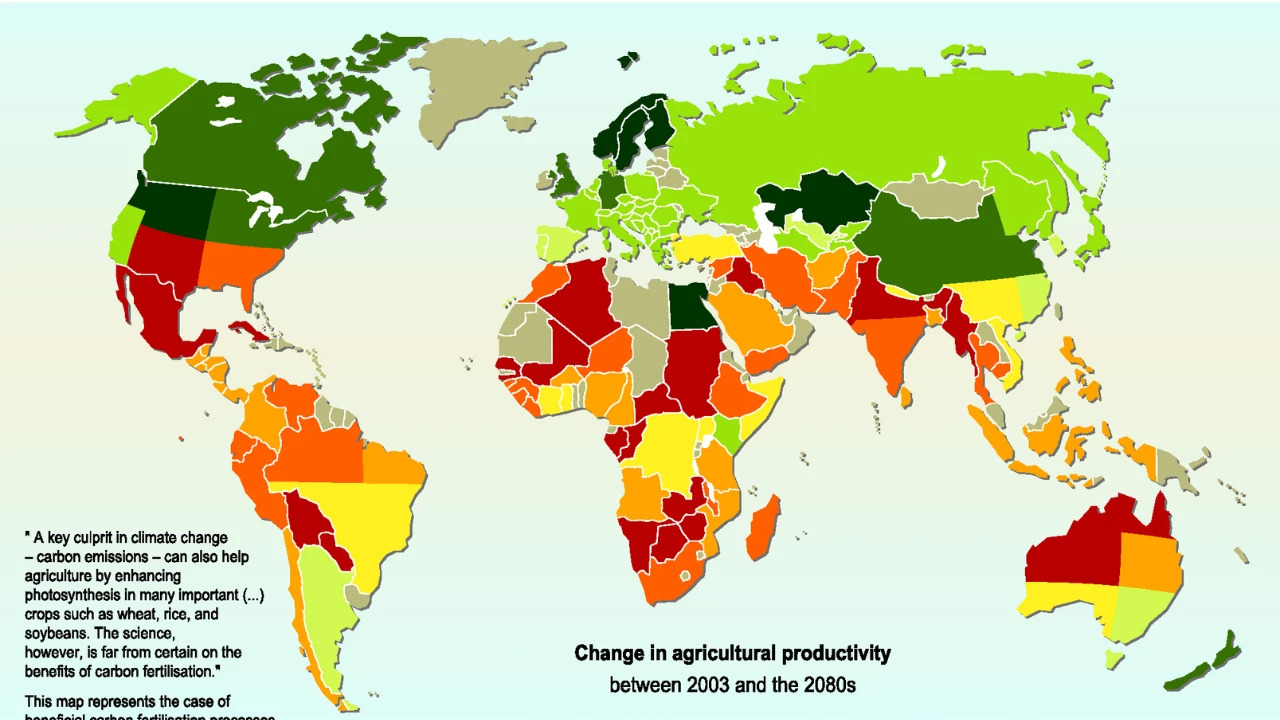
The researchers’ projections become more severe under continued high emissions. The official EGU abstract reports that annual global losses could quadruple between 2019 and 2070 under the SSP3-7.0 high-emissions pathway, while the extended projections reported by New Scientist estimate that yields could fall by around 35% by 2100 and annual financial losses could exceed $161 billion. That would be roughly eight times the current annual cost, with production losses potentially reaching about 855 million tonnes each year.
The scale matters because maize and wheat already sit at the center of the global food system. According to the Food and Agriculture Organization’s agricultural production statistics, maize, wheat and rice together accounted for 91% of global cereal production in 2023, illustrating how disruption to a small number of major crops can reverberate through food, livestock-feed and commodity markets.
The projections come with an important uncertainty
The researchers acknowledge that estimating agricultural conditions decades into the future is difficult because farmers will adapt, potentially through irrigation, crop switching, altered planting dates and new varieties. Other scientists have also cautioned that statistical relationships derived from historical conditions become less reliable when extended into climate conditions far outside the historical record.
The estimates may nevertheless exclude other major sources of damage, since the analysis covers only three crops and focuses on heat and drought rather than floods, storms and other climate hazards. The central finding is therefore not that the exact 2100 loss is predetermined, but that heat and drought are already imposing measurable costs on global agriculture, while future emissions and adaptation decisions will help determine how much larger those losses become.
This article has been republished from The Times of India.